It's Time to Get Your English Passives Right
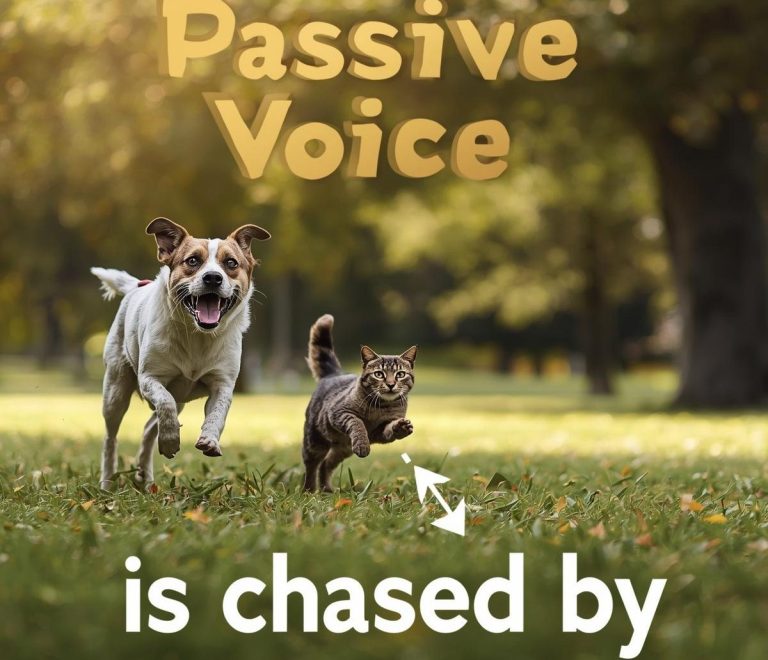
Active vs Passive Voice
The Passive Voice: Not Just for Shy Verbs!
Present:
The dog chases the cat.
vs
The cat is chased by the dog.
Past:
The dog chased the cat.
vs
The cat was chased by the dog.
As a learner of English, you've likely encountered the passive voice in your studies. While it may seem tricky at first, understanding and using the passive voice can significantly enhance your English language skills. In this guide, we'll explore what the passive voice is, when to use it, and how to construct it correctly.
What's the Passive Voice, Anyway?
- In the world of passive voice - subjects take a backseat and objects get their moment in the spotlight. It's like a grammatical magic trick where we make the doer disappear and the receiver becomes the star of the sentence show!
- Imagine you're at a party. In the active voice, you're the life of the party, doing all the action. But in the passive voice, you're the wallflower who things happen to. It's not about what you do, it's about what's done to you. How mysterious!
When to Use This Grammatical Invisibility Cloak
- When you broke mom's favourite vase and don't want to admit it was you.
- When you want to sound fancy and scientific.
- When you're writing a spy novel and the identity of the secret agent must remain... secret.
How to Pull Off This Sentence Swap
- Take your sentence's object ('the cat') and promote it to subject (it's like giving the underdog - here a 'cat' - the lead role). It moves to the front of the sentence.
- Sprinkle in a form of "to be" (is, am, are, was, were... - pick your flavour). (was)
- Use the past participle (3rd form=V3) of the main verb (it's like the verb's fanciest outfit). (chased)
- Optionally, mention who did the action with "by" (if you're feeling generous) at the end. (by the dog)
See the Magic Formula Visual for extra simplicity!
Magic Formula Visual for Passive Voice
From active to passive:
[👤 SUBJECT] → [✋ V1/V2/V3] → [📦 OBJECT]
↓
[📦 OBJECT] → [✋ be + V3] → [👤 by SUBJECT]
Forms of be
↓
✅am, are, is (present)
✅was/were (past)
✅(will) be (future)
✅(have/has/had) been (perfect)
✅(am/are/is/was/were) being (continuous)
So again, the passive voice is a grammatical construction where the subject of a sentence receives the action of the verb, rather than performing it. Simply saying, passive voice shifts focus—who or WHAT gets the attention/spotlight!
- Active: The dog chased the cat.
- Passive: The cat was chased (by the dog).
- Active: Scientists have discovered a new planet.
- Passive: A new planet has been discovered (by scientists).
In the passive sentence, the cat (the recipient of the action) becomes the main character (jumps to the front), while the dog (the doer of the action) is moves to the end of the sentence or can be omitted entirely. Similarly, a new planet comes into focus and the scientists become almost unimportant.
The passive voice is useful in several situations:
- When the doer of the action is unknown or unimportant:
- "My car was stolen last night." (We don't know who stole it.)
- To emphasize the recipient (the receiver) of the action:
- "The Mona Lisa was painted by Leonardo da Vinci." (The focus is on the painting.)
- In scientific or academic writing to maintain an objective tone:
- "The experiment was conducted under controlled conditions."
- To be tactful or diplomatic:
- "Mistakes were made." (Instead of directly naming and blaming someone)
Quick Recap
To form the passive voice, follow these steps:
- Shift the focus from the main character to the other (or from the main thing to the other) to start the passive sentence.
- Use the appropriate form of "be" (is, am, are, was, were, will be, etc.).
- Use the past participle (V3) of the main verb.
- (Optional) Add "by" followed by the original 'hero' if you want to include the doer of the action.
Passive in Present, Past and Future Tenses
Simple Tenses Preview
PRESENT | PAST | FUTURE
🍎 is | 🍎 was | 🍎 will be
eaten | eaten | eaten
Continuous Tenses Preview
PRESENT | PAST
🍎 is being | 🍎 was being
eaten | eaten
Perfect Tenses Preview
PRESENT | PAST | FUTURE
🍎 has |🍎 had | 🍎 will have
been | been | been
eaten | eaten | eaten
The magic formula stays the same across all tenses. Only 'be' changes. See how:
Present Simple
A: The dog chases the cat.
P: The cat is chased by the dog.
Past Simple
The dog chased the cat.
The cat was chased by the dog.
Present Continuous
The dog is chasing the cat.
The cat is being chased by the dog.
Past Continuous
The dog was chasing the cat.
The cat was being chased by the dog.
Present Perfect
The dog has chased the cat.
The cat has been chased by the dog.
Past Perfect
The dog had chased the cat.
The cat had been chased by the dog.
Future
The dog will chase the cat.
The cat will be chased by the dog.
(It's worth noting that in some tenses passive is not used by native speakers; those would sound unnatural.)
If you are curious, see all existing tenses in passive voice (for the purpose of observing structures) in the last section.
Everyday Passive Sentences + Funny Examples
Everyday Passive Voice: Common Examples You’ll Encounter
- Active: The chef cooked a delicious meal.
Passive: A delicious meal was cooked by the chef.
- Active: The teacher graded the exams.
Passive: The exams were graded by the teacher.
- Active: The kids built a sandcastle.
Passive: A sandcastle was built by the kids.
- Active: Someone stole my bike.
Passive: My bike was stolen (by someone).
- Active: The company launched a new product.
Passive: A new product was launched by the company.
- Active: The doctor will examine the patient.
Passive: The patient will be examined by the doctor.
- Active: The artist painted a beautiful mural.
Passive: A beautiful mural was painted by the artist.
- Active: The team won the championship game.
Passive: The championship game was won by the team.
- Active: They are cleaning the house today.
Passive: The house is being cleaned today (by them).
- Active: The mailman delivered the package.
Passive: The package was delivered by the mailman.
10 Hilarious Examples to ‘Passive-ify’ Your Life (all in past tense)
- Active: The dog ate my homework.
Passive: My homework was eaten by the dog.
- Active: The toddler threw spaghetti all over the walls.
Passive: Spaghetti was thrown all over the walls (by the toddler).
- Active: A mysterious force devoured (=ate up) all the cookies in the jar.
Passive: All the cookies in the jar were devoured (eaten up) by a mysterious force.
- Active: The cat knocked over the priceless vase.
Passive: The priceless vase was knocked over by the cat.
- Active: The wind blew away my toupee.
Passive: My toupee was blown away by the wind.
- Active: A giant squid stole my submarine.
Passive: My submarine was stolen by a giant squid.
- Active: Aliens abducted my neighbour’s cow.
Passive: My neighbour’s cow was abducted by aliens.
- Active: The washing machine ate my favourite sock.
Passive: My favourite sock was eaten by the washing machine.
- Active: A rogue AI hacked my smart fridge.
Passive: My smart fridge was hacked by a rogue AI.
- Active: The grammar police arrested me for overusing passive voice.
Passive: I was arrested by the grammar police for overusing passive voice.
Remember, using the passive voice is like wearing a disguise in your sentences. Sometimes it's useful, sometimes it's fun, but don't overdo it - or you might find yourself being chased by angry English teachers wielding red pens! Now go forth and passivize responsibly! May your objects be subjects and your verbs be past participles.
All Tenses in Passive Voice
A review of construction of passive voice in all tenses
(You only need to know the most common ones; focus on 1-4. Some - especially complicated continuous tenses - are not used at all!)
The passive voice can be formed in most English tenses, but some are more common than others. Here's an overview of how to form the passive in different tenses, along with their relative frequency of use:
Most Common Passive Tenses
1. Simple Present
Active: They clean the office every day.
Passive: The office is cleaned every day
2. Simple Past
Active: The chef prepared the meal.
Passive: The meal was prepared by the chef.
3. Present Perfect
Active: Someone has stolen my wallet.
Passive: My wallet has been stolen.
Frequently Used in Official, More Formal Situations
4. Future Simple
Active: They will announce the results tomorrow.
Passive: The results will be announced tomorrow.
5. Present Continuous
Active: They are repairing the road.
Passive: The road is being repaired.
6. Past Continuous
Active: They were building the house when I visited.
Passive: The house was being built when I visited.
7. Past Perfect
Active: They had completed the project before the deadline.
Passive: The project had been completed before the deadline.
8. Future Perfect
Active: They will have finished the work by next week.
Passive: The work will have been finished by next week.
Usually Avoided
9. Present Perfect Continuous
Active: They have been painting the house for weeks.
Passive: The house has been being painted for weeks.
10. Past Perfect Continuous
Active: They had been discussing the issue for hours.
Passive: The issue had been being discussed for hours.
11. Future Continuous
Active: They will be serving dinner at 8 PM.
Passive: Dinner will be being served at 8 PM.
12. Future Perfect Continuous
Active: They will have been working on the project for a year by then.
Passive: The project will have been being worked on for a year by then.
It's important to note that the passive forms of continuous perfect tenses (9, 10, 11, 12) are rarely used in English due to their complexity. Native speakers often prefer to rephrase such sentences using simpler constructions. The most commonly used passive forms are in the simple present, simple past, and present perfect + future simple tenses (1,2,3,4). These cover most everyday situations where the passive voice is appropriate and useful.
Passive Structure in Simple Present, Past, Future + Present Perfect (The Most Common Passives)
🔴Object 🟡BE 🟢V3 🔵by Subject
🍎 is eaten (by me)
📧 was sent (by her)
🏠 will be cleaned (by them)
🍎 has been eaten (by me)
Also explore:
All English Past Tenses with Tips, Plenty of Examples & Dialogues
Use, Used, Used to, Get Used to: The 'Use' Guide
Parts of Speech for Intermediate Learners
The Language of Virtual Meetings
or
Find your favourite topic in the Intermediate Level English Learning Resources section
Common Mistakes to Avoid
- Overusing the passive voice: While useful, overuse can make your writing unclear or wordy.
- Forgetting to change the verb tense: The tense should be reflected in the "to be" verb, not the main verb.
- Using the passive voice with intransitive verbs: Only transitive verbs (verbs that take an object) can be used in the passive voice.
Practice Makes Perfect
Like any aspect of language learning, mastering the passive voice takes practice. Try rewriting active sentences in the passive voice, and vice versa. Pay attention to its use in books, articles, and conversations to understand when and how native speakers employ it.
Remember, the passive voice is a tool in your English language toolkit. Use it wisely, and it will add depth and sophistication to your communication skills. Happy learning!