Don’t, Doesn’t, Didn’t, Haven’t, Hasn’t: A Simple Guide to Negative Contractions
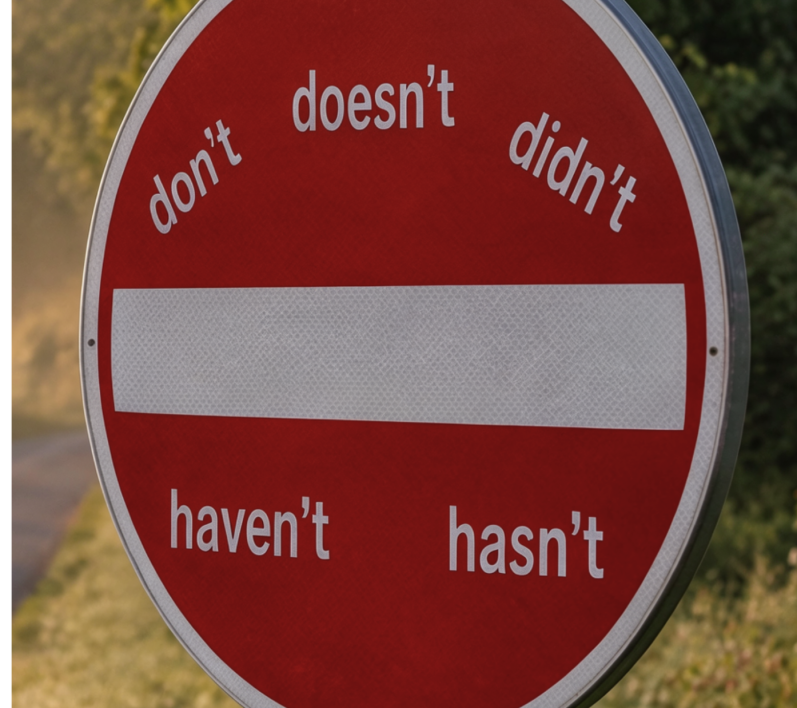
Learn the difference between don’t, doesn’t, didn’t, haven’t and hasn’t with easy rules, clear examples and common mistakes.
Five Small Words, Two Simple Families
Don’t, doesn’t, didn’t, haven’t and hasn’t are negative contractions. They all make sentences negative, but they are used in different tenses and with different subjects. This simple guide explains when to use each form, shows clear examples, highlights common mistakes, and includes a short practice quiz.
Don’t, doesn’t, didn’t, haven’t and hasn’t all make sentences negative, but they do different jobs. The confusion usually disappears when you see that they belong to two families:
- The do family: don’t, doesn’t, didn’t — these make ordinary verbs negative.
- The have family: haven’t, hasn’t — these make the present perfect negative.
In Present Simple
Don’t /Doesn't: Present Simple Negative
Don't
Use don’t with I, you, we and they in the present simple.
- I don’t understand this word.
- You don’t need to hurry.
- We don’t have class tomorrow.
- They don’t live in Paris.
- My parents (‘they’) don’t like cold weather.
Use don’t for habits, routines, facts, preferences and general situations:
- I don’t drink tea.
- They don’t work at weekends.
- We don’t agree with that idea.
Common mistake
- ❌He don’t like coffee.
- ✅He doesn’t like coffee.
Don’t is only for I, you, we and they. For he, she and it, use doesn’t.
Doesn't
Use doesn’t with he, she and it in the present simple.
- He doesn’t like early mornings.
- She doesn’t speak French.
- It doesn’t work.
- My brother doesn’t eat meat.
- The shop doesn’t open on Sundays.
After doesn’t, use the base form of the verb — not the -s form.
- ✅She doesn’t work here.
- ❌She doesn’t works here.
- ✅It doesn’t rain much in summer.
- ❌It doesn’t rains much in summer.
Common mistake
- ❌He doesn’t likes coffee.
- ✅He doesn’t like coffee.
The -s appears on does/doesn’t, so it does not appear again on the main verb.
What if “do” is the main verb?
Sometimes do is the main verb, meaning perform an activity.
- I don’t do sport very often.
- You don’t do any exercise.
- They don’t do the shopping on Mondays.
- We didn’t do much at/on the weekend.
- He doesn’t do housework.
- She doesn’t do her homework before dinner.
- It doesn’t do any harm.
Notice the pattern: don’t/doesn’t + do.
- ✅I don’t do my homework at night.
- ❌I don’t my homework at night.
What if “does” is the main verb?
When does means perform an activity, use doesn’t do:
Compare:
- He doesn’t like coffee. — like is the main verb.
- He doesn’t do the cooking. — do is the main verb.
In Past Simple
Didn’t: Past Simple Negative
Use didn’t for finished actions in the past. It works with every subject: I, you, he, she, it, we and they.
- I didn’t sleep well last night.
- You didn’t tell me.
- He didn’t come to the meeting.
- She didn’t send the report.
- We didn’t have time.
- They didn’t understand the instructions.
Didn’t is the past negative of both don’t and doesn’t:
- Present: I don’t know. → Past: I didn’t know.
- Present: She doesn’t work here. → Past: She didn’t work here.
Common mistake
After didn’t, use the base form of the verb.
- ❌I didn’t went to the party.
- ✅I didn’t go to the party.
- ❌She didn’t saw the email.
- ✅She didn’t see the email.
The past meaning is already in didn’t, so the main verb does not need to be past too.
Did can be the past form of do as a main verb.
- I did my homework last night.
- She did the dishes after dinner.
- They did yoga this morning.
To make these negative, use didn’t do:
- I didn’t do my homework last night.
- She didn’t do the dishes.
- They didn’t do yoga.
Compare:
- ✅I did my homework.
- ✅I didn’t do my homework.
- ❌I didn’t my homework.
What if “did” is the main verb?
In Present Perfect
Haven’t / Hasn't: Present Perfect Negative
Haven't
Use haven’t with I, you, we and they in the present perfect.
The structure is:
haven’t + past participle (3rd form)
- I haven’t finished my homework.
- You haven’t met my brother.
- We haven’t decided yet.
- They haven’t received the email.
- My friends haven’t visited Berlin.
Hasn’t: Present perfect negative with he, she, it
Use hasn’t with he, she and it in the present perfect.
The structure is:
hasn’t + past participle (3rd form)
- He hasn’t finished the project.
- She hasn’t called me today.
- It hasn’t stopped raining.
- My boss hasn’t replied to my message.
- The train hasn’t arrived yet.
Common mistake
- ❌I haven’t saw that film. / She hasn’t saw that film.
- ✅I haven’t seen that film. / She hasn’t seen that film.
After haven’t and hasn’t, use the past participle: seen, done, gone, finished, received, written...
- ❌ She haven’t been to London.
- ✅ She hasn’t been to London.
After she/he/it use hasn’t.
What if “have” is the main verb?
Have as the main verb: present negatives
When have is the main verb, it can mean possess, experience, or eat/drink: have a car, have time, have lunch. In modern standard English, use don’t have or doesn’t have for the negative in present tense.
- I don’t have a car.
- You don’t have time today.
- We don’t have a meeting tomorrow.
- They don’t have any questions.
- She doesn’t have much work experience.
A useful extra: Compare the two sentences with the same meaning:
- ✅I don’t have a pen. — Preferred by most speakers
- ✅I haven’t got a pen. — More common in British English
Have as the main verb: past negatives
For a finished past time, use didn’t have. The past time is carried by didn’t, so the main verb returns to its base form: have, not had.
- I didn’t have breakfast yesterday.
- She didn’t have enough money last month.
- We didn’t have a car when we lived in the city.
- They didn’t have time to finish the task.
Common mistakes
- ❌I didn’t had breakfast.
- ✅I didn’t have breakfast.
- ❌She didn’t had a phone.
- ✅She didn’t have a phone.
Use didn’t have with completed time expressions such as yesterday, last week, in 2022, and when I was younger.
Have as the main verb: present-perfect negatives
Use haven’t had with I, you, we, they, and hasn’t had with he, she, it, when the situation began in the past or belongs to a time period that continues until now. The structure is haven’t / hasn’t + had (past participle of ’have’).
- I haven’t had breakfast yet.
- We haven’t had any news today.
- They haven’t had a holiday this year.
- She hasn’t had time to call.
- He hasn’t had a coffee yet.
- My phone hasn’t had a signal all morning.
Common mistakes
- ❌She hasn’t have lunch.
- ✅She hasn’t had lunch.
- ❌We haven’t have any problems.
- ✅We haven’t had any problems.
Use haven’t had / hasn’t had with expressions such as yet, today, this week, this year, since, and for. These forms connect a past situation to the present.
See the difference
- I didn’t have lunch yesterday. — Yesterday is a finished past time.
- I haven’t had lunch today. — It is still today, and lunch may still happen.
- She didn’t have a car in 2020. — A finished past situation.
- She hasn’t had a car for two years. — The situation continues up to now.
Quick Reference and Exercises
Quick reference: Choose the right form
If the sentence is…
Present simple negative with I / you / we / they, use don’t
I don’t know.
Present simple negative with he / she / it, use doesn’t
She doesn’t know.
Past simple negative with any subject, use didn’t
They didn’t know.
Present perfect negative with I / you / we / they, use haven’t
We haven’t finished.
Present perfect negative with he / she / it, use hasn’t
He hasn’t finished.
Two questions to check yourself
Before choosing a negative contraction, ask:
- Is it present simple, past simple, or present perfect?
- Present simple → don’t / doesn’t
- Past simple → didn’t
- Present perfect → haven’t / hasn’t
- Is the subject he, she or it?
- Yes → doesn’t or hasn’t
- No → don’t or haven’t
Practice: Choose the correct form
- She _ like spicy food. (don’t / doesn’t)
- I _ go to the party yesterday. (didn’t / haven’t)
- They _ finished the report yet. (haven’t / hasn’t)
- He _ work at weekends. (don’t / doesn’t)
- We _ seen that film. (didn’t / haven’t)
- My phone _ have enough battery. (doesn’t / hasn’t)
- She _ called me yesterday. (didn’t / hasn’t)
- I _ my homework last night. (didn’t / didn’t do)
Answers: 1. doesn’t; 2. didn’t; 3. haven’t; 4. doesn’t; 5. haven’t; 6. doesn’t; 7. didn’t; 8. didn’t do.
Final tip
If you remember only one thing, remember this:
- Don’t, doesn’t, didn’t help ordinary verbs become negative.
- Haven’t, hasn’t help the present perfect become negative.
- When do or have is the main verb, it usually needs another helping verb to become negative: don’t do, didn’t do, don’t have, doesn’t have.